| |
Guidelines for Responsible Horse Guardianship
 Physical Health Physical Health
The foundation of good horsekeeping is
basic husbandry and health care. All horse owners should
know their horses, understand what is normal and abnormal, and
establish a relationship with an equine veterinarian for
everything from health maintenance to emergency care.
Emotional
Health
Horses evolved as social animals grazing on the open plains,
ever watchful for danger. They need companionship. If your
horse is alone most of the time, you should consider getting a
second horse or other animal, such as a goat, for company.
Horses in the wild may walk great distances and spend most of
their time eating grass. Horses with insufficient opportunity
to socialize, move, and graze are more likely to have
behavioral problems, and there are health consequences as
well. Given a choice, most horses prefer to be outside under
most conditions, even when we’d be uncomfortable. Whenever
possible, horses should be allowed on pasture with other
horses every day.
Training & Handling
Humane training is based on a thorough understanding of the
nature of horses. By any name, it is not a recent discovery.
The basic principles were espoused two thousand years ago in
ancient Greece by Xenophon who explained that nothing graceful
can be forced.
A good deal of learning, experience or guidance is needed to
be an effective teacher of horses. On a very fundamental
level, it involves applying and releasing pressure to tell the
horse what to do and if he is doing it. Too often, horses are
punished for being frightened, confused, or unable to do what
is asked, or because the human half of the partnership does
not recognize that the horse is trying. The more refined the
art, the more subtle the cues, corrections, and rewards.
There is no place for fear, “flooding” the horse with
stressful overstimulation, or physical punishment, except
possibly to prevent a horse from injuring himself or someone
else. Many horses, however, suffer not from punishment but
excessive “rewards.” Spoiling your horse can have health
and behavior consequences and turn him into a horse nobody can
handle. Give your horse love, care, guidance, patience, and
understanding for free. Save the treats for a purpose and use
them wisely.
It is irresponsible to have a completely untrained horse who
can’t be handled if someone else will ever have to take care
of him. Every horse should at least learn to accept being
caught, haltered, led and loaded on a trailer. It may save his
life.
 Disabilities
& Old Age Disabilities
& Old Age
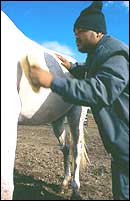
Plan ahead for when your horse gets older, or otherwise
becomes incapable of doing the things you once did together.
He can be a valuable companion for another horse, yours or
someone else’s. He can be a valued companion for you, and a
reminder that we must follow through on our responsibilities.
He still needs good care and attention, probably more than
before, a diet appropriate to his age and condition, mental
stimulation, and exercise.
Transfer of Ownership
Do not sell your horse at auction, or to a horse trader
you don’t know well. There are alternatives. Be wary of people
overly willing to take a “problem horse” off your hands. Be
honest and forthcoming, ask a lot of questions, check
references, and visit his potential new home if possible.
Consider a contract giving you “right of first refusal” should
the new owner be unable to keep him. Be realistic about the
value someone else will place on your horse, and what his
quality of life is likely to be.
End of Life Decisions
In most cases, there is no easy answer to the question of when
living on would be worse than a quick and painless death. Your
horse’s veterinarian should explain the problems and
prognosis, give you an idea of how much he may be suffering,
and help you make a decision, but can not make it for you. It
may be the hardest decision you have to make. Don’t become
paralyzed waiting for the “right time” or worrying that you
missed it. Horses live in the present, and that is your
primary concern.
Article courtesy: The American
Society for the Prevention of Cruelty to Animals.
Printed with permission.
Complete list of
articles
|
|